
Extension of Jing-Hu High-Speed Rail Line
Since the inauguration of the Jing-Hu (Beijing-Shanghai) High-Speed Rail Line in 2011, which has become the world’s most profitable rail route and significantly reduced the travel time between Beijing and Shanghai to just 4.5 hours, the success has led to the necessity of a second line due to capacity saturation.
The Unique Route of the Jing-Hu Second Line
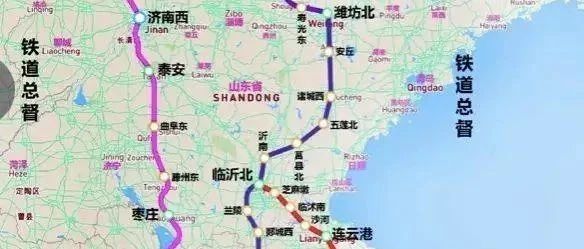
Unlike the straight route of the first line, the second Jing-Hu line takes a significant detour, connecting cities like Dongying and Weifang that previously lacked high-speed rail services. Moreover, the number of stations on the second line is nearly double that of the first line, primarily to aid in poverty alleviation and to more equitably distribute the benefits of high-speed rail to economically lagging areas.
Cities Along the Jing-Hu Second Line
In addition to Beijing and Shanghai, the second line passes through cities including Tianjin, Binzhou, Dongying, Weifang, Rizhao, Linyi, Xuzhou, Suqian, and Huai’an. Notably, in Shandong Province, the line includes 13 stations such as Wudi Station, Dongying South Station, and Shouguang East Station, connecting the north and south like a string of bright pearls.
The Bright and Shadow Sides of the Second Line
While the Jing-Hu Second Line has brought rapid connections to many small towns, promoting rapid economic development, it also faces challenges. Regrettably, the entire route cannot maintain a uniform speed of 350 km/h, and it might impact the profitability of the first Jing-Hu line in the short term.
The Social Significance of the Second Line
Despite some drawbacks, considering the social significance and poverty alleviation role of the Jing-Hu Second Line, these issues seem less critical. The line has connected more cities and villages, turning previously isolated areas into new transportation hubs, injecting new vitality into local economies and cultures.
Gradual Economic Benefits
Over time, the economic benefits of the Jing-Hu Second Line will become increasingly apparent. The national long-term planning for high-speed rail and the importance of poverty alleviation outweigh short-term economic considerations.
Pride and Anticipation for Hometowns
For those whose hometowns are on the line, imagine the convenience of traveling easily across the country by high-speed rail. For those whose hometowns are not yet listed, do not be disheartened as the high-speed rail network continues to expand, and your city may also become part of it in the future.
Jing-Hu Second Line: Connecting Hopes and Dreams
The Jing-Hu High-Speed Rail Second Line is more than just a railway connecting two major cities; it connects countless people’s hopes and dreams. Its construction represents a bold decision, symbolizing wider and deeper social and economic connections.
Leave a Reply