
On the vast lands of China, a dragon-like high-speed rail stretches its presence into nearly every corner. Imagine this scenario: you board this swift dragon in Beijing and, in just a few hours, find yourself strolling the streets of Shanghai, the “Magic City.” Isn’t that an astounding experience? In the hearts of the masses, high-speed rail has become the epitome of speed, modernity, and convenience.
Many cities eagerly wish to connect with this swift dragon, hoping to become vital hubs in the transportation network. However, today’s narrative is somewhat different. In the winding mountains of Yunnan, the small town of Yangzong has nurtured a unique marvel — the Yangzong Station.
This high-speed rail station, located in Chengjiang City, was completed in 2016. Yet, to this day, it has not welcomed a single passenger. In fact, over the past seven years, this costly and expansive station has remained untouched by travelers.
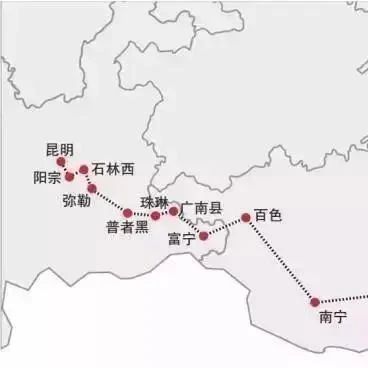
One might wonder why such a “lonely” high-speed rail station exists. Yangzong Station is not merely a stopping point; it’s a crucial link in the grand “Eight Vertical and Eight Horizontal” railway network, specifically part of the Guangzhou-Kunming corridor.
This corridor, gloriously known as the “Golden Passage,” connects China’s southwest to its south, extending like a radiant belt toward the vast ocean. The establishment of Yangzong Station was filled with endless aspirations.
Officials hoped that this strategic transport hub would inject new economic vitality into Chengjiang, bringing unprecedented opportunities to the area. The Nanjing-Kunming High-Speed Rail, with its significant mission, aims to closely connect the economic giants of the south with the charming city of Kunming.
Along this 710-kilometer route, there are 17 stations, and Yangzong Station is one of these pearls.
However, as time flows like water, there seems to be a clash between the blueprint and reality of Yangzong Station. Two other stations, each less than 50 kilometers away, echo its presence. This means that shortly after departure, the high-speed train needs to slow down for another stop, and soon after, stop again for Yangzong Station. For a mode of transport known for its speed and efficiency, this undoubtedly poses a technical challenge.
With a population of only 170,000 and a not-so-thriving commercial scene, Chengjiang presents a harsh reality: even if the gates of Yangzong Station were wide open, the flow of travelers might remain sparse.
This isn’t just the sad song of Yangzong Station. It reflects a broader issue: in our planning and construction, we might have overlooked the real needs and situations of local areas, driven only by the pursuit of scale, numbers, or other goals.
This is not just a loss of money but also a missed opportunity and a waste of precious resources. Looking ahead, how should we plan and decide for future railway stations? The planning and decision-making for future stations must be more prudent.
We need to delve into the grassroots, understand the true face of local areas, and ensure that every station’s existence is logical and not just built to fulfill a certain objective. Additionally, the distance between stations should be carefully considered to ensure that high-speed trains can fully utilize their speed advantage.
High-speed rail is our pride and also our responsibility. We hope that every station can be as bustling as Beijing and Shanghai, rather than waiting in silence for the dawn like Yangzong Station.
Leave a Reply